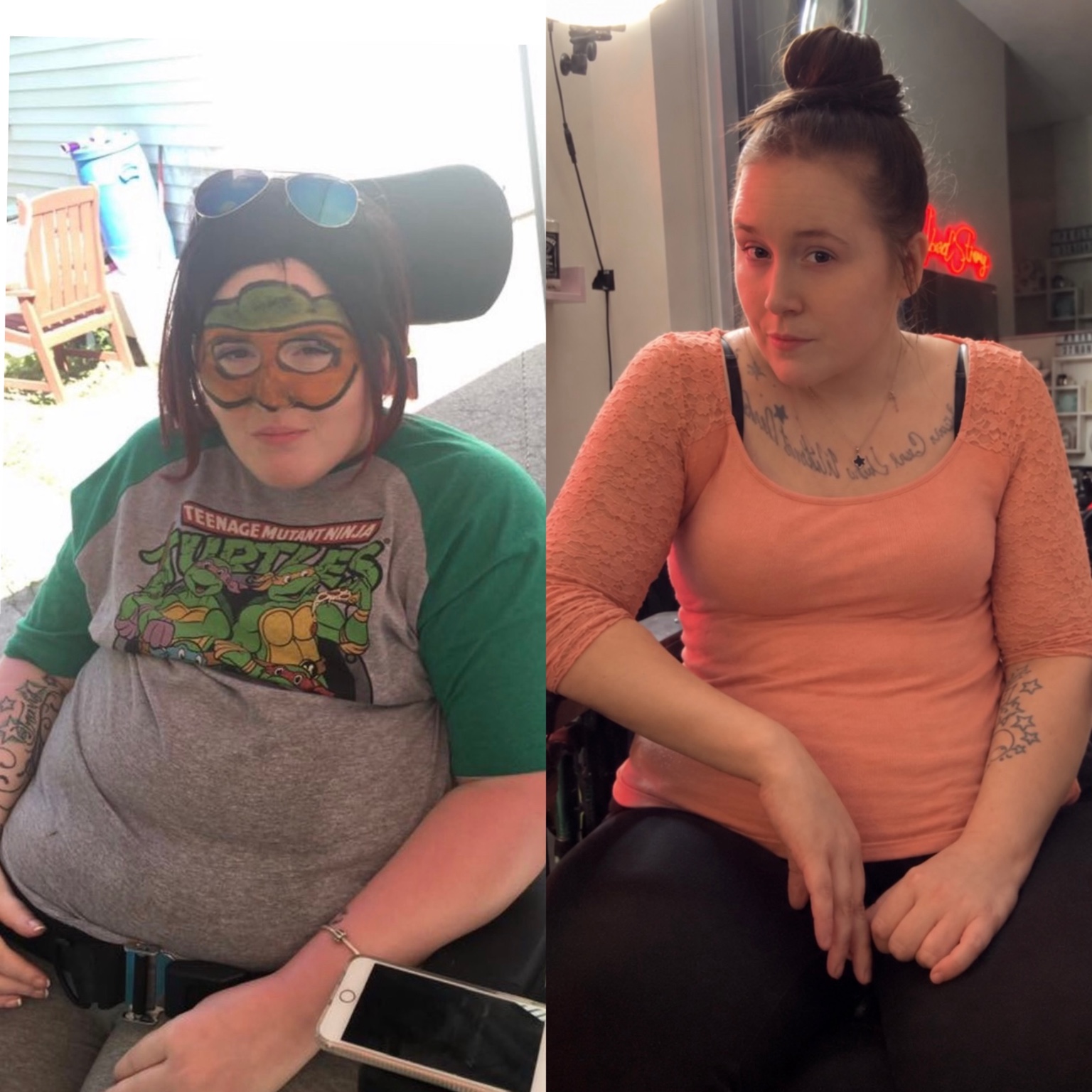
For everyone who has asked how I lost weight after seeing my photo, I wanted to finally sit down and explain what actually changed.
I want to start with something important.
This did NOT happen overnight.
There was no miracle diet. There was no supplement that suddenly melted the weight off. There was no magical exercise. There was no thirty day transformation.
This took years.
Years of learning my body, paying attention to my habits, getting stronger, changing the way I thought about food, working on my mental health, learning about nutrition, understanding my triggers, and figuring out what actually works for MY body as a quadriplegic.
And I am still working on it.
Before I get into what helped me, I also need to make one thing very clear.
Every Paralyzed Body Is Different
Please do not look at my body, my progress, or one photo and think your body should respond exactly like mine.
Paralysis is not one universal experience.
Our neurological injuries are different. Our levels of function are different. Our muscle activation is different. Our recovery is different. Our medications can be different. Our hormones can be different. Our metabolism can be different. Our pain, spasticity, mobility, sleep, circulation, digestion, and daily lives can all be different.
Some people may be able to voluntarily activate muscles that another person cannot. Some people may regain certain functions over time. Others may not.
Some people may have a much harder time losing weight for reasons that have absolutely nothing to do with discipline or how badly they want it.
That is neurology. That is physiology. That is life with a spinal cord injury.
So this is not me telling every disabled person, “Do exactly what I did and you will get the same result.”
This is me sharing what I learned from MY body and what helped me.
Hopefully, parts of it can help someone else learn their body too.
The Little Things Matter More Than We Think
One of the biggest lessons I learned was that sometimes it is not one giant problem. It is a bunch of little things happening every day.
Maybe you have a coffee in the morning. An iced tea during the afternoon. A soda later that night.
None of those things sounds like a huge deal by itself. But repeat them every day and those calories start adding up.
That was a big realization for me.
I was never someone who constantly drank soda, juice, energy drinks, and every sugary beverage imaginable. I did have my little soda addiction at one point, but this was more about noticing the smaller habits.
I started asking myself:
Do I actually need this?
Not: “Am I never allowed to have this again?”
Not: “This is bad and I am bad if I drink it.”
Just: Do I care enough about this to spend calories on it every single day?
Sometimes the answer is yes. Enjoy the damn thing.
But sometimes I realized I was consuming something simply because it had become part of my routine.
And when you are paralyzed, those little choices can matter even more.
Depending on the level and completeness of a spinal cord injury, paralysis can significantly change muscle mass, body composition, activity levels, and daily energy expenditure.
I cannot simply decide tomorrow that I am going to walk an extra 5,000 steps.
So I had to become more intentional about the energy I was putting into my body.
I Changed the Way I Look at Food
I LOVE food. I love flavor. I enjoy eating.
I do not believe that becoming healthier means forcing yourself to eat bland food you hate for the rest of your life.
Food should taste good.
But I also started reminding myself that food has a biological job.
Food is fuel.
Protein provides amino acids that the body uses to build and repair tissue. Carbohydrates can provide energy. Dietary fats are essential for many functions in the body. Fiber supports digestion and helps feed parts of our gut microbiome. Vitamins and minerals participate in countless biological processes.
Food can absolutely be pleasurable, cultural, emotional, social, and enjoyable.
But underneath all of that, our bodies still need nutrients.
When I say I started viewing food more like medicine, I do NOT mean food replaces actual medicine. It does not.
I mean I started asking a different question:
What is this food actually doing FOR my body?
What nutrients am I getting? Is it keeping me full? Is it helping me get enough protein? Does it have fiber? Does it give me energy? How does it make me feel afterward? Is it supporting what I am trying to accomplish?
We just happen to have figured out how to make our fuel taste really fucking good too.
And I am perfectly fine with that.
I Was Eating More Processed Food Than I Realized
This was another eye opener for me.
I was not sitting around eating chips, cookies, frozen dinners, candy, and fast food all day. Honestly, I thought I ate pretty well.
But I started realizing that some foods I never mentally categorized as “processed foods” were much more processed than I thought.
Take spaghetti sauce.
You grab a jar and think: tomatoes, garlic, herbs, maybe olive oil. Simple.
Then you turn the jar around.
Depending on the brand, you might find added sugars, oils, thickeners, preservatives, flavorings, large amounts of sodium, or ingredients you were not expecting.
That does not mean every jar of spaghetti sauce is unhealthy. It does not mean every food additive is dangerous.
It means I learned to LOOK.
That became one of my biggest rules:
The front of the package is marketing.
Turn that bitch around.
Read the ingredients. Look at the nutrition facts. Compare products. Learn what you are actually buying.
There may be two products sitting next to each other that look almost identical from the front, but when you turn them around, they are completely different.
Sugar Free Does Not Automatically Mean Healthy
This is another thing I started paying much more attention to.
People see words like sugar free, low carb, keto, low fat, protein, natural, zero sugar—and we automatically associate those words with healthy.
Sometimes they can help you find a product that fits your goals. But those words do not tell you the entire story.
If something is sugar free, I want to know: What did they replace the sugar with?
Some products contain sugar alcohols, which can cause gas, bloating, cramping, or diarrhea in some people. Some contain non-nutritive sweeteners. Some contain gums, fibers, emulsifiers, starches, fillers, or combinations of ingredients that may affect digestion differently depending on the person.
And when it comes to artificial sweeteners, the gut microbiome, blood sugar, appetite, and insulin resistance, the research is much more complicated than social media likes to make it.
I am not going to tell you every artificial sweetener is poison.
I am also not going to assume something is automatically good for me because somebody printed ZERO SUGAR across the front of the package.
Read. Learn. Pay attention to your body.
A Tool That Can Help You Learn Food Labels
If you are overwhelmed when you first start looking at ingredient lists, one tool you can try is the Yuka app.
You can scan products and get additional information about their ingredients. Its rating can be a starting point for questions, but it cannot tell you exactly how your own body or gut will respond to a food.
I do not think any app should replace learning how to read a nutrition label and ingredient list yourself. But when you are starting out, tools can help make the learning process easier.
Use the tools. Then educate yourself enough that eventually you understand what you are looking at.
Gut Health Became Part of My Weight Loss Journey
I also started paying much more attention to my gut.
The gut microbiome is an incredibly complex ecosystem made up of microorganisms living in and around our digestive tract.
And no, I do not believe every health problem starts in the gut. I do not believe one probiotic is going to fix your entire life.
But I do believe the health of our digestive system deserves attention.
The foods we repeatedly eat influence the environment inside our gut. Fiber matters. Plant diversity matters. Hydration matters. Medications matter. Antibiotics matter. Sleep matters. Stress matters.
Different foods can also affect bloating, digestion, comfort, and appetite differently from person to person.
So I started paying attention.
What makes me feel good? What leaves me bloated? What keeps me satisfied? What gives me energy? What foods actually nourish me? What am I eating repeatedly?
Sometimes we spend so much time asking whether something will make us gain or lose weight that we forget to ask whether it actually makes our body feel good.
I Had to Work on My Mental Health Too
This part was just as important as changing what I ate.
Eventually, I realized I had to stop only asking: What am I eating?
And start asking: WHY am I eating?
That question opened up an entirely different part of this journey.
Was I actually hungry? Was I stressed? Was I bored? Was I upset? Was I frustrated? Was I rewarding myself? Was I eating because something was sitting in front of me? Was I craving sugar because I had not eaten enough earlier? Was I looking for comfort? Was something simply part of a routine I had repeated so many times that I stopped questioning it?
Sometimes the answer really was: “I am hungry.”
Then EAT.
Hunger is not a moral failure.
But sometimes I realized food was answering a question my body had never asked.
That is where I had to start learning my triggers.
A Craving Does Not Have to Become an Action
This was huge for me.
Wanting something does not mean I have to immediately do something about it.
That sounds simple until you actually try to practice it.
I had to learn how to experience a craving without treating it like an emergency.
One of the biggest mindset changes I made was changing:
“I can’t have that.”
into:
“I could have that. I am choosing not to right now.”
Those two sentences feel completely different inside my head.
“I can’t” feels like restriction. “I choose” feels like agency.
That helped me develop discipline without turning discipline into punishment.
I also started reminding myself:
I can want something without needing it right now.
I am not being deprived. I am making a decision.
This craving will pass.
My goals matter more to me than this five minute impulse.
I do not need to be perfect. I need to be consistent.
One decision does not ruin my progress, and one healthy decision does not create it either.
What I repeatedly do matters more than what I occasionally do.
Those thoughts became part of the work too.
Discipline Is Not the Same as Punishment
When people hear discipline, sometimes they imagine white knuckling your way through hunger and misery.
That was not what I needed.
I needed systems.
If I know something is a major trigger for me, maybe I do not need ten of them sitting within reach.
If I am absolutely starving every night, maybe I need to look at whether I am eating enough protein, fiber, or food earlier in the day.
If I crave something sweet at the same time every night, maybe part of that craving is habit.
If I am eating because I am stressed, maybe I need another tool for managing stress.
That could be meditation, breathing, journaling, music, calling somebody, doing something creative, changing my environment, sitting with an uncomfortable feeling for a few minutes, or distracting myself until the immediate urge passes.
Sometimes I ate emotionally. Sometimes I still do. I am human.
The difference is that I started becoming aware of it.
And awareness gives me an opportunity to make a different choice.
Movement Still Matters When You Cannot Walk
This is one of the biggest things I want disabled people to hear.
Movement matters.
But movement does NOT have to look like walking.
Our bodies benefit from movement, but what movement looks like needs to depend on the individual body.
For me that included things like stretching, range of motion, upper body exercise, resistance work, assisted movement, working the muscles I could voluntarily activate, and trying to improve strength little by little.
If you want to explore some of the equipment and tools that may help make movement more accessible, here is my Amazon adaptive workout equipment list. What works depends on your own function, positioning, and support needs, so treat it as a place to get ideas rather than a one-size-fits-all workout plan.
For some people, NMES or FES may also be useful options when medically appropriate.
And movement is not only about burning calories.
That is something I think gets lost in weight loss culture.
Movement can support joint mobility, strength, muscle preservation, circulation, flexibility, positioning, comfort, function, independence, and overall health.
Five minutes matters.
Doing something you could not do six months ago matters.
Moving a joint through range of motion matters.
Strengthening one muscle matters.
Progress does not have to look like an able-bodied workout video to count.
I Worked on My Stomach With the Function I Had
For me personally, I also worked on the abdominal function I had available.
At first, I could not do very much. Then I got a little stronger. And because I was stronger, I could do a little more. Then a little more.
That became part of my progress.
But this is where I need to repeat something important.
Not every quadriplegic is going to be able to do what I can do.
Somebody may not have voluntary activation in those muscles. Somebody may have a different injury level. Somebody may have different neurological recovery. Their adaptive training may need to look completely different from mine.
That does not mean they are lazy. It does not mean they are not trying hard enough.
It means their nervous system and muscles function differently.
Adaptive fitness needs to actually be adaptive.
That is one of the reasons I am working on creating an adaptive workout playlist.
I want to create movement options for people with different abilities instead of pretending there is one universal disabled workout.
My goal is to have that project moving forward by the end of the year as I finish my certification and continue building Wheel Strong.
Want to hear when the Real Strong adaptive workout videos are released? Join the WheelStrong mailing list for updates on the project and its release.
Circulation and Lymphatic Flow Matter Too
Movement serves another purpose that I think deserves more attention in people with limited mobility.
Muscle contractions normally help support circulation.
Movement also helps with the movement of lymphatic fluid through the body’s lymphatic vessels.
The lymphatic system plays important roles in fluid balance and immune function.
When large areas of the body are not moving normally, the usual muscle pumping action may be reduced.
That is one reason stretching, assisted movement, repositioning, range of motion, breathing, and other appropriate forms of movement can be valuable beyond calorie expenditure.
Some people may also benefit from professionally guided approaches to swelling or lymphatic concerns.
But I want to be very clear about something because the wellness industry loves confusing these things:
Lymphatic drainage is not fat loss.
If someone loses excess fluid, they may look or feel less swollen.
That is not the same biological process as losing body fat.
Both things can matter. They are simply different.
Let’s Talk About the Quad Belly
Yes…
Mine is STILL THERE.
I want to say that because I never want somebody looking at one photograph and assuming I somehow completely eliminated my quad belly.
I did not.
Some days my stomach looks flatter. Some days it does not. Some days I am more bloated. Some days my posture is better. Some days my positioning is better. Some days my body simply looks different.
Bodies do that.
And quad belly is not necessarily just abdominal fat.
Paralysis can change abdominal muscle function. It can change trunk support. It can change pelvic positioning. It can change spinal and seated posture. It can change the way the rib cage sits. It can change how the abdominal wall supports what is inside of it.
So yes, losing body fat may change your abdomen.
But losing weight does not erase the neurological and mechanical effects of paralysis.
For me, working on my stomach meant several things: reducing body fat, working whatever abdominal muscles I could access, getting stronger, stretching, working on posture, paying attention to positioning, reducing bloating when possible, and understanding that what I see in the mirror is influenced by more than one thing.
That helped me stop looking at my stomach like it was simply a problem that needed to disappear.
Posture Matters More Than People Realize
When you spend most or all of your day seated, posture and positioning matter tremendously.
The position of the pelvis changes how the abdomen sits. The position of the rib cage changes the appearance and mechanics of the torso. Trunk support affects how the body carries itself.
Posture can also influence things like comfort, breathing mechanics, pressure distribution, and shoulder mechanics.
Again, posture does not burn abdominal fat.
But posture can absolutely change how your body looks and functions.
Those are different things. Both matter.
This Was Never Just About Getting Smaller
One of the biggest shifts for me was realizing that I did not simply want the smallest number possible on a scale.
I wanted to become healthier. I wanted more strength. I wanted more function. I wanted better nutrition. I wanted more independence. I wanted to preserve whatever muscle I could. I wanted to understand my body better. I wanted to feel more confident inside of it.
That is a completely different goal than simply trying to shrink yourself.
And I think that distinction matters even more when you are living with paralysis.
Because muscle is precious. Function is precious. Independence is precious.
So my goal is not to starve myself until a scale gives me a number I like.
My goal is to build the strongest, healthiest version of THIS body that I can.
The Little Changes Added Up
When people ask me what finally worked, I think they expect one big answer.
There really was not one.
I stopped wasting calories on things I did not care about. I paid attention to what I was drinking. I started reading ingredients. I became more selective about foods I thought were healthy. I focused more on protein, fiber, whole foods, and nutrient dense foods. I paid attention to my gut. I learned what makes me feel good and what makes me feel like shit.
I worked on my mental health. I asked myself why I was eating. I identified triggers. I learned that cravings do not control me. I practiced discipline without turning it into self punishment.
I moved my body however I could. I stretched. I worked on strength. I trained my stomach within the abilities I have. I paid attention to posture. I thought about circulation. I thought about lymphatic flow.
And then…
I kept doing those things.
For years.
Not perfectly.
Consistently.
There is a difference.
Five minutes of movement. Choosing water instead of a drink I did not really care about. Reading one ingredient label. Choosing a better sauce. Eating more protein. Adding more fiber. Stretching. Doing one more exercise than I could do before. Stopping for ten seconds and asking whether I am actually hungry. Recognizing a trigger. Letting one craving pass without reacting to it. Learning what bloats me. Learning what fuels me. Learning my body. Learning my mind.
Each choice feels tiny by itself.
But repeated over months and years?
Those choices can become an entirely different way of living.
This Is Why I Started Wheel Strong
This entire journey is one of the biggest reasons I created Wheel Strong.
My vision for Wheel Strong has never been just workouts.
I want to help people living with spinal cord injuries and disabilities become stronger from the inside out.
Yes, I want to help people become physically stronger.
But I also want to talk about everything surrounding that strength.
Nutrition. Adaptive fitness. Mindset. Mental health. Confidence. Body image. Neuroplasticity. Stress. Habits. Independence. Learning your changed body. Rebuilding your relationship with yourself after injury.
I want people to understand that healing after a life changing injury can have more than one meaning.
Sometimes healing means improving function. Sometimes it means getting stronger. Sometimes it means becoming more independent. Sometimes it means adapting. Sometimes it means grieving what changed while still building something meaningful with what remains. Sometimes healing happens internally long before anybody else can see it externally.
That is the vision behind Wheel Strong.
Helping people become stronger physically. Helping people become stronger mentally. Helping people heal internally. Working on what we can externally. Helping people understand their bodies. And helping people build as much confidence, function, health, and independence as their bodies allow.
Because health and fitness should not feel like they were designed for everybody except us.
I Am Still Doing the Work
I do not consider myself finished.
I am still learning my body. I am still learning about nutrition. I am still working on my strength. I am still working on my posture. I am still working on my mindset. I am still noticing triggers. I am still learning when to push myself and when to give myself grace.
I still have a quad belly. I still have days when I am bloated. I still have cravings. I still make choices that are not perfect. I am still human.
This was never about becoming perfect.
It was about becoming more aware.
And then using that awareness to make better choices more often.
The little calories added up.
But so did the little changes.
There was no one secret. There was no miracle diet. There was no magical exercise.
There were hundreds of small physical and mental decisions repeated long enough to start changing my life.
And I am still doing the work.
I am still learning my body.
I am still working on my mind.
And I am still working on me every single day.
Leave a Reply